Baptism: 25 May 1817, Lambeth, Surrey, England
          Died: 1 Feb 1890 Westbury, Tasmania, Australia
Wife: Catherine BURKE
          Born: ~1829 Ireland
          Died: 22 Sep 1893 Westbury, Tasmania, Australia
       Married: 29 Jan 1855 Launceston, Tasmania, Australia

Children:
      Catherine
          Born: 3 Jan 1855 Westbury, Tasmania, Australia
          Died: 19 May 1936
       Married: 14 Jul 1875 Westbury, Tasmania, Australia
        Spouse: Isaac JAMES

      Thomas
          Born: 4 Oct 1856 Westbury, Tasmania, Australia
          Died: 5 Jul 1920
       Married: 14 May 1884 Westbury, Tasmania, Australia
        Spouse: Rosetta MORRIS

      Nathaniel
          Born: 6 Dec 1858 Westbury, Tasmania, Australia
          Died: 20 Aug 1920

      Mary Jane
          Born: 7 Jul 1860 Westbury, Tasmania, Australia
          Died: 9 Jun 1926
       Married: 4 Apr 1883 Westbury, Tasmania, Australia
        Spouse: William WEBB
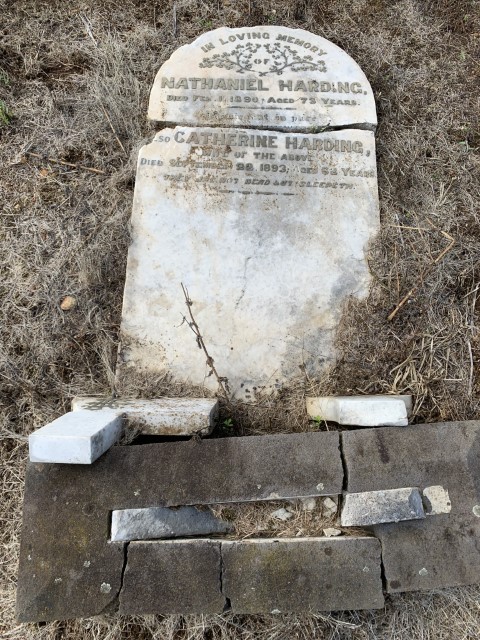
IN LOVING MEMORY
OF
NATHANIEL HARDING
DIED FEB 1. 1890; AGED 73 YEARS Requiescat in pace
ALSO CATHERINE HARDING
WIFE OF THE ABOVE
DIED SEPTEMBER 22 1893; AGED 62 YEARS
THEY ARE NOT DEAD BUT SLEEPETH.
The Chains that Bind Us.
Lee-Ann Atkinson June 2022
NATHANIEL HARDING
Born 1817 Lambeth, Surrey, England
Police no.1649
Tried: Kent Quarter Sessions 9 Apr 1833
Crime: Stealing a handkerchief from the person at Greenwich fair
Sentence: 7 years
Jail: Maidstone
Ship: Isabella 13 Nov 1833
A young fresh-faced boy named Nathaniel Harding was taken up at the Greenwich fair accused of stealing a handkerchief. It was suggested the teenager was part of a gang that frequented the fair grounds. He was confined to Maidstone prison to await his next court appearance. Nathaniel appeared at the Kent quarter sessions on 9th Apr 1833 where he was found guilty, receiving a 7-year jail sentence. Two weeks later, on the 23rd April, Nathaniel was transferred to the Retribution hulk anchored at Woolwich. Conditions onboard were cramped, damp and unsanitary, allowing diseases like cholera, dysentery, and typhus to spread amongst the cohort. (1) (2)
Maidstone Prison:
The Assize Court and the Prison stand at the top of Week Street on a plot of 14 acres. Together they form a fine structure of Kentish rag, a type of grey-white limestone and were built in 1818 at a cost of £200,000. The building commenced with a four-storey roundhouse with the addition of multi-level cell blocks. The courthouse is located at the front and is used both for assizes and for quarter sessions. The prison was initially built to accommodate 552 prisoners, including male and female inmates.(3)(4)
Retribution Hulk:
Each morning at seven o’clock, convicts capable of work were rowed ashore and put to work at various kinds of labour, digging canals, driving in posts to protect the riverbank from erosion. Each working party consisted of between 16 and 20 men in chains with an overseer.
The prisoners were returned to the hulk for dinner, which consisted of boiled meat of the oldest and cheapest kind along with a small piece of bread or a putrefied biscuit. On two days during the week, the meat was substituted with cheese and oatmeal. The food supplied to the hulks was by a contract at the lowest price and quality. The authorities were always keen to keep costs down. In the summer months, the men worked for up to ten hours a day; during the winter months, seven hours per day. (5)(6)
Convict Transport Isabella:
Two and half months later, on the 5th July, Nathaniel was transferred to the convict transport Isabella for the journey to Van Diemen’s Land. The surgeon superintendent assigned to the Isabella for the voyage was Oliver Sproule. Sproule recorded the first of several cases of Cholera amongst the prisoners and the soldiers. Edward Williams, a 23-year-old convict was diagnosed with cholera malignant and put on the sick list at Sheerness. He succumbed to the illness on 16 June. Before the Isabella set sail, several of the soldiers and convicts had already died from Cholera.
Three hundred men and boys were crammed onboard, 100 more than the vessel usually accommodated. The surgeon states ‘they had fully as much accommodation as they required’, due to the new way of fitting out the prison. On the 10th and 11th of June, 100 convicts from the Justicia hulk at Woolwich and a further 51 from the Retribution were received. The last bunch arrived on 5th July, consisting of 100 men from the Cumberland and 50 boys from the Euryalus hulk at Chatham. Seven prisoners, including Nathaniel, were received from the Retribution to replace those that had already died. The surgeon did not have anything positive to say about Nathaniel’s behaviour during the voyage although the hulk report stated he was orderly. The journey from Plymouth took 109 days, arriving in the Derwent on the 14th November. (7)
Shortly after arrival at Hobart Town, the troublesome boys were removed to Point Puer on the Tasman Peninsula. Charles Booth, commandant of Port Arthur, had prepared a barracks for the boys although the remainder of the area was undeveloped. Most of the boys were young and unskilled, aged between twelve and seventeen. The boys were to be educated and given skills they could use once released.
They were described as ‘street-wise’ and ‘hulk -wise’ boys and soon became ‘prison-wise’ and ‘bush-wise,’ which is borne out by Nathaniel’s charge sheet. A total of nineteen separate charges resulted in sixteen sentences of solitary confinement ranging from forty-eight hours to fourteen days, along with a three-month stint in the cells at Port Arthur and two of corporal punishment.(8)
Boys were regularly caught stealing food and tobacco to use to barter with. On 15th September 1834, Nathaniel was charged with giving provisions to a prisoner belonging to the establishment at Port Arthur and received five days in solitary confinement. On a separate occasion, secreting a cask of pork on the wharf, which was being unloaded from the brig Tamar, he received 14 days solitary confinement.
Point Puer
The reformatory opened, in 1834 with 66 boys and grew to 716 boys. The establishment became overcrowded, and consisted of three main buildings, containing barracks, workshops, cookhouse and bakehouse. The second building was used as a chapel and school and residence for the younger boys, the third the jail. They slept on the floor packed together. They were watched over by overseers, most of the convict class. (9)
The daily routine began at 5.30am with rolling up the bedding, washing and attending prayers. The breakfast bell rang at 8:15am and the boys would assemble on the muster ground for inspection. Following breakfast until noon, learn a trade and general labour. Dinner was at 1 o’clock. Work resumed between 2 and 5. Following supper, the boys attended lessons until 8pm.
They received a bland diet of flour, fresh or salted meat, green vegetables when available and potato. Dinner usually consisted of soup, a small piece of bread and a dumpling. For supper, the boys were fed gruel and bread.
The boys’ clothing consisted of a jacket and a pair of trousers made from tanned sheep skin, a waistcoat made from grey cloth and under the waistcoat they wore a striped shirt. They were also given a leather cap and boots. Their bedding was made from coarse sacking, along with two blankets which they rolled out like a rug each night.
The boys were taught skills and had the opportunity to become shoemakers, tailors, sawyers, coopers, carpenters, blacksmiths, stone cutters, boatbuilders, bookbinders, bricklayers, and gardeners.
Nathaniel regularly drew the attention of the overseers and served more time in solitary confinement than his counterparts. He was regularly in trouble because he was singing or talking to himself in his cell, resulting in a longer period of confinement.
It wouldn’t come as any surprise if he said “I have been damned to hell” at least once. It is evident Nathaniel didn’t learn very much during his time at Point Puer, as he spent more time in solitary confinement than he did in a classroom.(10)
Discipline
Badly behaved boys didn’t fear being sent to jail, because they had much the same food, and their labour was outside in the open air. The authorities were growing tired of Nathaniel’s behaviour, and he received solitary confinement and was only allowed bread and water.
Following his release from Point Puer, Nathaniel resided in a wooden cottage at 12 Goulburn Street, Hobart, owned by W. Smith. The household consisted of five persons; two former male prisoners, one former female prisoner and one adult female and a female child under 7 years of age. Many boys were returned to Hobart without any prospects of finding work and left to compete for work alongside skilled free men. (11)
A few months later, Nathaniel ran afoul of the law and was arrested on suspicion of burglary at the home of George Smith. On the 19th April [1842] he is tried for theft of a watch guard and sundry items valued at 2/-. Mary Ann Gosling was arrested and charged with receiving the stolen items and later acquitted. This time he was found guilty and sent to Port Arthur. (12) Nathaniel’s time at Port Arthur was cut short when he joined Green, Woolley and Thomas and hatched a plan to escape. The escapees robbed Matthew Teague of money and supplies. The details were vividly recounted in the Colonial Times.
Verdict: The men were found guilty of the robbery but not of the charge of violence and were given a life sentence. During this time, authority over the prison on Norfolk Island was transferred to Van Diemen’s Land. Prisoners who were convicted of serious crimes were to be sent to the island and once convicts completed their sentence were deemed to have served the necessary period, were removed to Tasmania.
Whilst on Norfolk Island (NI) Nathaniel’s recalcitrant behaviour did not improve, he was repeatedly put in chains. He served a total of 16 months hard labour in chains.
Norfolk Island
The second Convict Settlement at Kingston on Norfolk Island earned a reputation for being hell in paradise. Joseph Childs took up his duties as commandant on the island on 7 February 1844. He was reputed to be a strict disciplinarian. The rations provided for the convicts consisted of salt beef and maize meal and on Saturday afternoons the prisoners were allowed to grow sweet potatoes on plots of land set aside for cultivation. Childs was a brutal administrator and instrumental in causing a riot as a result of confiscating the prisoners’ cooking utensils and preventing them from growing their own vegetables.
On the 1st July 1846, Jackey Jackey a well-known bushranger, assembled a large crew and attacked the overseers and constables. It resulted in the deaths of four men and a number were seriously injured. Nathaniel witnessed the uprising firsthand but doesn’t feature in the list of men tried for the rebellion.(13)
John Giles Price was sent to Norfolk Island to restore law and order, replacing Commandant Childs. Price metered out floggings for trivial breaches and had a tendency towards using harsh punishment like his predecessor. It is said corporal punishment has the same effect as elsewhere, tending to degrade and harden their resolve. Following years of harsh punishment on Norfolk Island, Nathaniel became hardened to the rigorous treatment and any glimmer of living a normal life was beginning to fade. Following the riot, several convicts were returned to Tasmania on the government brig Lady Franklin.
Upon arrival, Nathaniel was sent to Port Arthur where he spent another 12 months’ probation before being eligible for a pass. Following his release from Port Arthur, he was hired for six months by Charles Flegg of Liverpool street, Hobart and shortly afterwards reverted to his old ways. He was charged with theft and received another 18 months sentence of hard labour in chains. By now he had grown accustomed to the abrasions on his ankles from the shackles. He worked for various people including Mr. Valliant, D. Room of Launceston.(14)
A young Irish lass named Catherine Burke caught Nathaniel’s eye. The same month, Nathaniel was granted a ticket of leave, he applied for permission to marry Catherine. Catherine, herself a convict, was assigned to W. McNair of Westbury.(15)
Nathaniel, now aged thirty-seven, married Catherine at the York Street Baptist Chapel in Launceston in the presence of George MacKneair and James Donaldson. The couple’s first child, Catherine, was baptized the same day.(16)(17) Nathaniel farmed at ‘Adelphi’ and the following year in October, Thomas was born. The family remained living and working at Adelphi where their third child, Nathaniel arrived in December 1858. Adelphi was a rural area situated approximately 9km south of Hagley between Cluan and the Oaks. The area got its name from the large property at the eastern end of Adelphi Road.(18) Charles Robert Prinsep acquired two 330 acres of land and later purchased two adjoining 450 acre lots which he named ‘Adelphi.’ The estate was originally managed by a paid overseer. In the late 1840s, the property was broken up into smaller farms and leased to tenant farmers.(19)
By 1860, the Harding family had moved into the township of Westbury, where Nathaniel was working as a shoemaker. The family was complete with the arrival of Mary Jane in July. Nathaniel rented a cottage in William Street owned by the wife of Robert Lyall, the licensee of the Westbury Inn. Nathaniel eked out a life for himself and his young family, making a fresh start in Westbury.(20) The family became immersed in local affairs, including sporting events and attending church. Westbury was predominately an Irish community and, given the fact Catherine was Irish, the family joined in the festivities on St. Patrick’s Day.
In 1889, Nathaniel purchased the Westbury Inn, and the business was very much a family affair. The licensing bench met for their second quarterly meeting on 6 May.(21)
Nathaniel took to his bed and died on the first day of February 1890. His grandson Edward James reported his death. Despite years of deprivation and hard labour, he lived to be seventy-two years old.(22)
Nathaniel’s remains were interred in the Westbury Catholic burial ground. His will, made a few weeks before his death, named his wife Catherine and youngest son Nathaniel executors. His final instructions were to sell his interests in the Westbury Inn to enable his executors to pay off all his debts. Before year’s end, the hotel was advertised for sale for £680 and described as a ten-room, solid brick structure with stables in fair condition.
Probate was granted on 6 Jun 1890 to Nathaniel Harding junior to the value £350. Repeated advertisements failed to attract a buyer for the hotel.(23)(24)
THOMAS HARDING
Thomas Harding was a keen member of the Westbury rabbit coursing club, winning several events including the Greyhound Stake’s with Keepsake. Rabbit coursing involved training greyhounds and other dogs breeds to chase a rabbit. He followed with success with his greyhound Billy
It is a legal, competitive activity in which dogs are tested on their ability to run, overtake and turn a hare, rather than a form of hunting aiming at the capture of game.
Westbury Rabbit Coursing club, Launceston Examiner, Fri 8 Aug 1884, p.3 (33)
Thomas Harding renewed the public license for the inn in December.
The following year fate delt the family a devastating blow. An alarm was raised shortly after ten on Sunday night when flames were seen leaping from the rooftop. The family having only retired for the evening escaped without injury.
The family were helped by their son-in-law, Isaac James, who provided them with temporary lodgings.
Isaac ran a successful bakery business and when he opened a new business in William Street Launceston, Thomas took over running the Westbury bakery.
Nathaniel Harding junior did not marry and remained living in Westbury. Following his mother’s death, he moved to Launceston. Thomas and his wife Rose and family moved to Victoria around 1912. Following the death of her husband in 1915, Mary Jane also went to live in Victoria.
SUPREME COURT.—CRIMINAL SITTINGS. (1844, March 12). Colonial Times (Hobart, Tas. : 1828 - 1857), p. 2. Retrieved December 23, 2020, from http://nla.gov.au/nla.news-article8754662
CRIMINAL SITTINGS OF THE SUPREME COURT. (1844, March 8). The Courier (Hobart, Tas. : 1840 - 1859), p. 2. Retrieved December 23, 2020, from http://nla.gov.au/nla.news-article2951365
NORFOLK ISLAND. (1846, September 23). The Cornwall Chronicle (Launceston, Tas. : 1835 - 1880), p. 730. Retrieved April 27, 2022, from http://nla.gov.au/nla.news-article65942585
ODDFELLOWS' SPORTS AT WESTBURY. (1891, March 18). Daily Telegraph (Launceston, Tas. : 1883 - 1928), p. 3. Retrieved April 16, 2020, from http://nla.gov.au/nla.news-article153392124